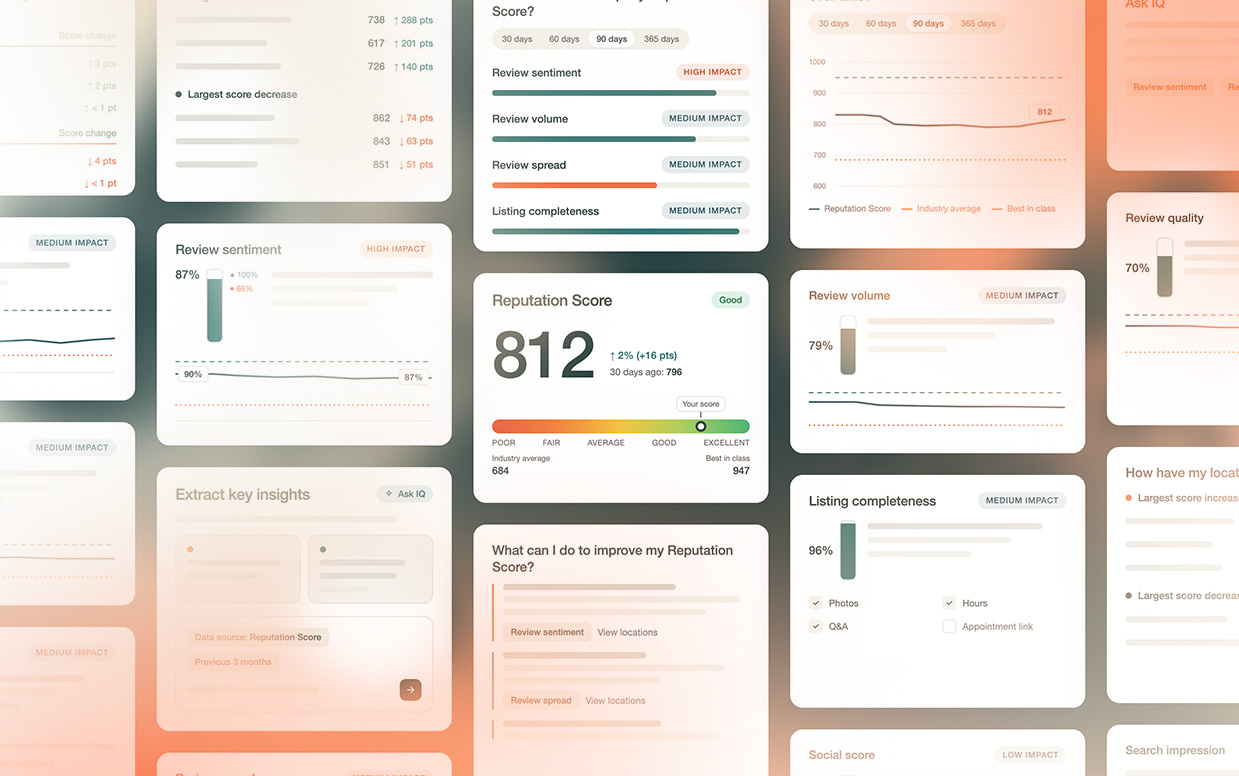
Reputation's Rep Score measures whether your brand deserves to be cited by AI answer engines. GEO Readiness measures whether it can be. The two scores are converging on the same question: is your brand citation-worthy? The direction of travel has been visible in Rep Score for two years.
Generative engine optimization (GEO) is the practice of making a brand’s content and reputation signals easy for AI answer engines, such as ChatGPT, Gemini, Perplexity, and Google’s AI Overviews, to find, understand, and cite. SEO earns a ranking; GEO earns a mention inside the answer itself.
Reputation Score (Rep Score), calculated by the Reputation platform, measures earned trust through ratings, review volume, and six other data points. The GEO Readiness Report measures something newer — whether the AI engines now answering your customers’ questions can find, parse, and trust that reputation well enough to cite it.
Rep Score and GEO Readiness look like two scores, but they increasingly work as one system. The trust layer inside GEO Readiness is fed by the same signals Rep Score has measured all along, and every recent change to Rep Score has pushed it closer to the form AI engines can actually read.
Key takeaways
- Rep Score (100–1,000) measures earned trust. GEO Readiness (0–100) measures whether AI engines can find, parse, and cite that trust.
- The Trust Signals pillar of GEO Readiness draws on the same review and listing signals Rep Score has always measured.
- Brands need both: a strong reputation AI can’t read is invisible, and structured data without earned trust isn’t credible.
What is a reputation score, and how is Rep Score calculated?
A reputation score is a single metric that summarizes how customers perceive a business across reviews, listings, and search. Rep Score is Reputation’s version: a number from 100 to 1,000, calculated in real time from eight signals across every location:
- Star ratings — how close you sit to five stars
- Review volume — the total body of feedback written about you
- Review spread — how many sites carry reviews for each location
- Review recency — whether feedback is current or stale
- Review quality — how specific and detailed the feedback is
- Search impressions — how prominently locations surface in search
- Listing completeness — photos, hours, departments, Q&A, appointment links
- Public score — publicly visible social signals across every location
Because Rep Score is built on the same third-party signals customers use to decide, it measures trust the way customers actually experience it.
What does the GEO Readiness score measure?
Reputation’s GEO Readiness Report is a free diagnostic that scores, on a scale of 0 to 100, how ready a brand is to be cited by AI answer engines like ChatGPT, Gemini, and Perplexity. It grades three signals:
- Discoverability — can AI find, crawl, and recognize your brand and location pages
- Answer Readiness — is your content written in compact, factual passages AI can extract, or marketing prose it skips
- Trust Signals — third-party validation, reviews, and sentiment — whether AI has reason to trust you
The third pillar, Trust Signals, is Rep Score — described in the vocabulary of AI search.
How do Rep Score and GEO Readiness compare?
Why are Rep Score and GEO Readiness separate scores?
Rep Score and GEO Readiness are separate because they were built for different eras: Rep Score for customers reading reviews and search results, GEO Readiness for customers reading AI-generated answers. Functionally, they are already one loop.
Rep Score answers whether you deserve to be cited. GEO Readiness answers whether you can be. A brand can score exceptionally on Rep Score and fail GEO Readiness: a strong reputation that answer engines cannot connect to the brand, parse from the page, or quote with confidence. Reviews exist, but AI cannot link them to you.
That is not a reputation problem. It is a legibility problem: AI engines can’t find, parse, or attribute the trust a brand has earned. Closing that gap is what the two scores now do together.
How has Rep Score changed to reflect AI search?
Over the past two years, three Rep Score updates have each made the score more machine-readable:
- Listing Accuracy became Listing Completeness . The score stopped asking whether the data is correct and started asking whether the structured fields are populated. That is an extraction metric.
- Review Length became Review Quality . The score stopped rewarding word count; and started rewarding recent, specific, factual reviews — exactly the quotable passages answer engines lift.
- Public Score moved to public data only. The score now reflects only what a crawler can actually see, at every location.
None of those were announced as AI moves. Every one of them made Rep Score more machine-readable.
Where is Rep Score heading?
Rep Score is becoming the trust engine underneath AI visibility — not a separate scoreboard beside it.
The convergence point is a single question: citation-worthiness. Are you the source an answer engine reaches for, and can it use what it finds? Rep Score supplies the credibility half of that answer. GEO Readiness supplies the legibility half and tells you which gap to close first, with the lift attached.
The same logic runs through how reputation data now travels. With reputation intelligence pushed into the AI tools teams already use, whether it’s ChatGPT, Gemini, or Perplexity, a marketer can ask why a score dropped in a specific market and get an answer in the tool they are already working in. That only works if the score is machine-legible in the first place. The score and the surface are converging from both directions.
How do you get your brand cited by AI engines?
Getting cited by AI engines takes three steps that run as a loop, with each score proving the other:
- Measure. GEO Readiness scores where you stand and exposes the gaps — structured location data, machine-readable ratings, service and specialty coverage.
- Publish. Reputation Pages closes those gaps by publishing structured brand truth for every location, so answer engines describe you the way you wrote it.
- Get cited. You become the source AI pulls from. Citations rise, and both scores climb.
Run either half alone and the loop stays open. Earn a strong reputation machines cannot parse, and you are absent from the answer. Structure data that is not backed by real earned authority, and you are readable but not credible.
Frequently asked questions
Do online reviews affect whether ChatGPT recommends a business?
Yes. Reviews are one of the third-party trust signals AI answer engines use when deciding which brands to cite. Recency, specificity, and volume all matter, which is why Rep Score measures each one.
What is a good Rep Score?
Rep Score runs from 100 to 1,000. The Rep Score estimator compares your number against your industry average and the top performers in your category.
What is the difference between SEO and GEO?
SEO earns a ranking on a search results page. GEO earns a citation inside an AI-generated answer. The two overlap, since crawlable pages and structured data help both, but GEO puts more weight on extractable, factual passages and third-party trust signals.
Will Rep Score and GEO Readiness become one score?
They are designed to work together rather than replace each other. Rep Score measures credibility on a 100–1,000 scale, with years of benchmark history behind it. GEO Readiness measures legibility on a 0–100 scale.
How do you measure your AI search readiness?
Two diagnostics give you a baseline in minutes. Start with the number you do not have yet.
Get your GEO Readiness Report. A free diagnostic that scores your AI search readiness in seconds — the three signals behind the number, and the prioritized fixes that move it.
Estimate your Rep Score. Eight questions, instant results, and a benchmark against your industry average and the top performers in your category.